Women’s Work:
An exploration of the role of women’s labor and involvement in the preliminary stages of the field of Computer Science
By Anne Schoonmaker
B.A. Computer Science and Interaction Design
Women’s work is a general term most often used to devalue and render invisible women’s labor and its contributions to society. More specifically, craftwork, like embroidery, knitting, and crochet, was ridiculed as insignificant and relegated to the general categories of irrelevance by those using such language. However, women’s labor and its relationship to craft have been fundamental to the creation and development of Computer Science, and originated many of the problem-solving approaches still used in the field today.
The very first programmer was a woman, Ada Lovelace; the term “computer” was originally a job title many women held.1 When companies advertised computer or programming jobs, many likened these positions to typically feminine pursuits like cooking or knitting to attract women to the field, as they were perceived to have a better disposition for programming.2
By using examples from the time’s advertisements, the words of employees, and recollections from the women themselves, each piece of embroidery on the clothing helps paint the picture of how integral women were to the field of Computer Science, especially at its inception.
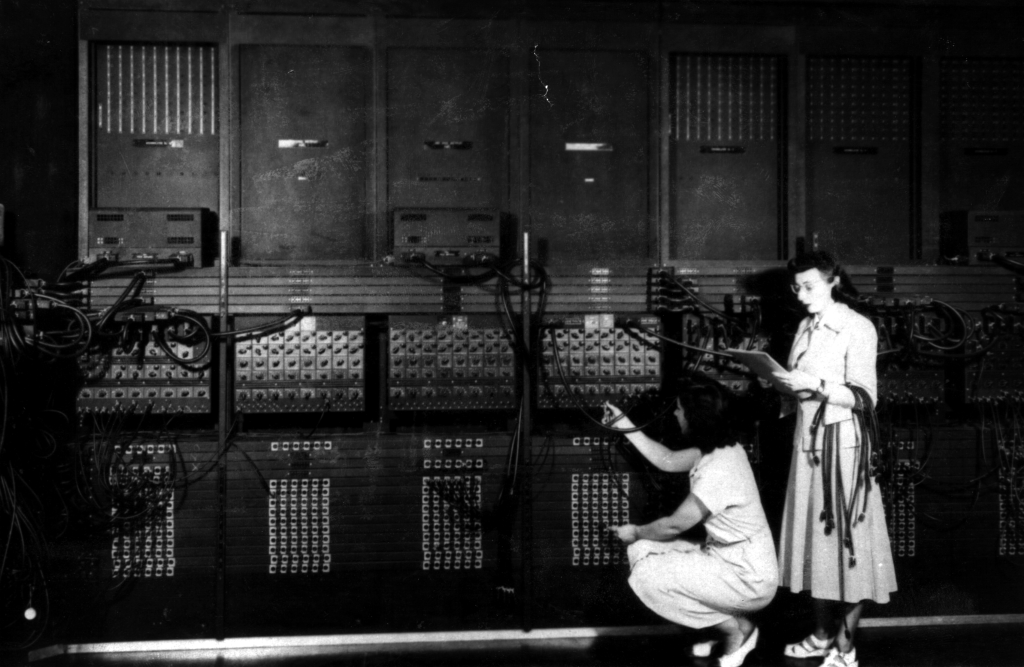
The clothes displayed through this project are modeled off the pieces that the first “computers” wore on the job. One photograph taken of programmers in the 1950s and 60s depicts the women of the ENIAC crouching down and connecting vacuum tubes. In another photo, Margaret Hamilton tests the Apollo module simulator. There was a thread connecting them: all the women were wearing skirts and uncomfortable looking shoes. These women got little to no recognition but were vital in learning the best ways to develop software and pushing the bounds of what a computer is capable of. Women programmers of the time were and still are under-recognized. These women were doing the same caliber of work, with more hindrances, their work attire being just one of them.
The process of embroidering the clothing was a multi-step endeavor. First, the artwork had to be drawn in Adobe Illustrator and placed into a processing Java file. Then, using the PEmbroider processing library, the drawing was converted into a pes file, compatible with the PE800 embroidery machine. While creating the embroidery patterns for the clothing was the majority of the thesis, work was also done to develop the library further. After finishing developing a new method for the library, which allows users to have a hoop sizing method letting them know how much space they have to work on their designs, this tool will be submitted to the library to improve the resources available to produce digital embroidery patterns.
“Women’s Work” showcases the untold stories of women in Computer Science, highlights the importance of craft, and emphasizes the power of women’s labor and how it transformed the field of Computer Science.
1 Thompson, Clive. “The Secret History of Women in Coding.” The New York Times Magazine. The New York Times, February 13, 2019.
https://www.nytimes.com/2019/02/13/magazine/women-coding-computer-programming.html. ; Loff, Sarah. “’Computer’ Conducts Data Analysis.” NASA. NASA, November 24, 2016.
2 Thompson, 2019.
Two Women Posed to Show the “Direct Programming” of ENIAC Done by Setting Hundreds of Wires and Thousands of Switches, in the Pre-Converter Code Days (an Instruction Code Written by Dr. John Von Neumann, Dr. Richard Clippinger, Jean Jennings Bartik and Adele Goldstine and Used for ENIAC Programming 1947-1955). Standing: Ester Gerston and Couching Gloria Gordon Bolotsky, Both “Computers” for the Army during WWII and Later Second-Generation ENIAC Programmers. “U.S. Army Photo” from the Archives of the ARL Technical Library. Historic Computer Images. Mike Muuss . Accessed April 22, 2023. https://ftp.arl.army.mil/ftp/historic-computers/#rights.
U.S Army Photo
 Women's Work